
2009 - Characteristics & Culture
MEXIPEDIUM XEROPHYTICUM
Characteristics and Culture
Marilyn M. LeDoux
Newsletter of the Peninsula Orchid Society, November 2009
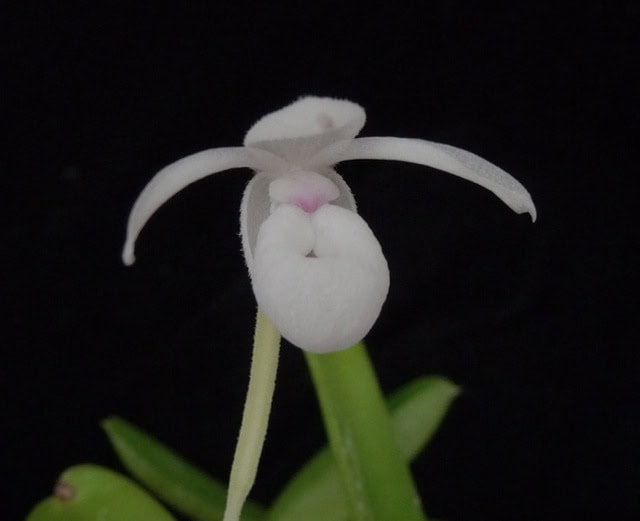
Mexipedium xerophyticum is a unique species from the southeastern Mexican state of Oaxaca that was originally described in 1990 as a Phragmipedium. It is, however, very different from all Phragmipediums in vegetative habit, with very thick succulent and relatively small leaves, and long above-ground rhizomes from which new growths develop. The diminutive white flowers are about one inch or slightly less in natural spread and have a pink tinge.
Habitat. In the warm and humid region of Oaxaca, Mexico the plants grow on vertical limestone cliffs without trees, in small cracks with humus or on the exposed rock. The cliffs face north and east so the plants are not totally exposed to the full intensity of the midday sun. The strongest plants are growing in the humus and not on naked rock. The elevation is 320 meters (1,050 Feet) above sea level and the area receives about 250 cm. (98 inches) of rainfall annually with a definite dry season during the spring. The average annual temperature is about 25 degrees C. (77 degrees F).
Plant Characteristics. This sympodial species has relatively short, rigid, fleshy light green leaves that are distichous and arranged in a fan shape. New growths develop from brittle, elongated, above-ground rhizomes. In its natural habitat one specimen with all its rhizomes and growths was reported to cover an area of about one square meter. Roots do not form from the rhizome itself, but only develop when the rhizome begins to flatten out and expand at the tip, forming a new plant.
Inflorescence. The sturdy wiry pubescent inflorescence is apical, arising from the center of the leaf fan. In my greenhouse it usually becomes visible as an inflorescence in March or April and begins blooming in May or June. The inflorescence is a panicle that can bear several usually short branches. The flowers on each branch are normally successive with one flower open at a time, but all the branches can certainly be blooming simultaneously. Inflorescences on mature plants can bloom for as long as six months, but a two to four month bloom period is average. The sturdy inflorescences need no staking.
Flower. In proportion with the small plant, the scentless flowers are also small but showy. Horizontal natural spread for AOS awarded cultivars range from 2.1 cm. to 2.7 cm. (about one inch or slightly more or less). The flowers are white flushed pink, especially on the outer surface of the dorsal sepal and on the staminode. The pointed petals are long, narrow, and arch inward, sometimes with a slight twist. The delicate rounded pouch has incurved margins and an inflated appearance. Individual flowers can remain fresh for approximately two weeks.
Culture. First it is important to consider the natural habitat of the plants: warm, humid, and growing on limestone rocks or in humus in the cracks of the rocks on east or north facing cliffs. I have grown and bloomed the plants successfully under artificial lights (a “Suncircle” for revolving light with one 1,000-watt metal halide bulb and one 1,000-watt high pressure sodium bulb) but even more successfully in the greenhouse. My best growth is obtained with light in the range of 3,500 to 4,500 foot-candles for at least four to five hours per day.
These plants love warm temperatures and are quite happy when summer heat reaches temperatures of 85-95 degrees F in my greenhouse on hot days. Even when the cooling pump went out in the summer and the temperatures reached 110 degrees F for several days the xerophyticums suffered no ill effects, unlike some of my other orchids. In nature where these grow, the average daytime high is 83-84 degrees F and nights are about 70 F. My greenhouse winter temperatures are generally around 60 to 62 degrees F at night, though cooling the temperatures to 55 degrees F in the autumn to help promote winter bloom of some other orchids does not seem to adversely affect the xerophyticums, though warmer temperatures are preferable. In nature the winter temperatures are 63-64 degrees F at night and 73-74 degrees during the day.
The humidity of the region from which the species originates is very high year-round, 80-90% even during the dry season. This high humidity is not necessary in cultivation, but plants will do better with adequate moisture in the air. In nature the plants experience heavy dew daily, so daily morning misting can be very helpful, especially in lower humidity situations. Plants growing on exposed cliff faces will naturally be exposed to excellent air movement so good air circulation in cultivation, especially in high humidity conditions, is important.
I thoroughly water my xerophyticums one to 3.5 times (every other day) per week, depending upon temperatures, light, condition of the potting media, and size of the pot. More watering is done under high temperatures and light conditions and less under cool cloudy conditions. Small pots are watered more frequently than larger ones. I also water new potting mix more frequently, and older, more decomposed, mix less often. The one aspect of the plant’s natural habitat that I ignore is that I do not decrease watering in the spring when the plants have a natural dry season. The plants are not picky about fertilizer and I usually water with a very weak fertilizer solution at least three out of four waterings. Occasionally using a fertilizer with calcium in it may be helpful, especially if there is not calcium naturally occurring in the water. With this species, and all other orchids, if reverse osmosis (R.O.) water or rain water is used, a fertilizer with micronutrients included should be used to prevent deficiencies in the plants.
Repotting and Dividing. My potting mix consists of 9 quarts of fine to medium sequoia bark, 4 quarts of extra fine (#4) to fine (#3) charcoal, 3 quarts of perlite, 3 quarts of Pro-Mix HP or similar peat-based potting mix, 1/2 cup bone meal, and 1/4 cup dolomitic lime. For plants in very small pots (2-3”) I use the fine bark and extra fine charcoal. For plants in larger pots I add in more of the larger size particles such as medium bark and fine charcoal and less of the smaller bark and charcoal. The bone meal is optional but be sure to use the dolomitic lime since these plants grow in areas of relatively soluble limestone rock.
As the plants grow larger and larger due to their long rhizomes, larger and larger pots can be used. I prefer plastic pots, and shallow pots are more preferable than deep ones, especially as the pot size gets larger. In pots over 6” in diameter, I prefer “bulb pans”, the most shallow type of pot. I also like to fill about 1/4 to 1/3 the depth of the pot’s bottom with styrofoam peanuts before adding potting mix.
Repotting this species can be intimidating, especially as the plants grow larger. Carefully knock the plant out of the pot and remove as much of the old mix and as many dead roots as possible, trying not to damage the live roots. This is a relatively sparsely rooted species so do not expect to find a pot full of roots. Carefully break or cut off any divisions you wish to remove, then repot the remaining main plant into a pot slightly larger than the size of the remaining growths. If some rhizomes extend beyond the pot’s edge, they can be carefully curved inward and pinned to the potting mix with long U-shaped bent wires. Newer rhizomes that are still reddish in color are the most brittle and hardest to flex without breaking, but older rhizomes with brown outer sheathing and new plantlets forming on the ends are somewhat more flexible and more easily moved into new positions without breaking. Before pinning down the new rhizomes with new plantlets forming, I like to put a small piece of moistened sheet moss under each new plantlet, then pin over the top of the rhizome behind the plantlet and into the sheet moss and down into the potting mix underneath. Morning mistings help keep the sheet moss somewhat moist and aid in the rooting of the new plantlets.
Die von der ursprünglichen Pflanze entnommenen Ableger mit einigen Wurzeln werden auf ähnliche Weise, aber in kleineren Töpfen eingepflanzt. Bei kleinen Ablegern ohne Wurzeln habe ich gute Erfahrungen damit gemacht, sie in kleine Töpfe mit feuchtem SphagnumFor the divisions removed from the original plant, those with some roots are potted up in a similar fashion but in smaller pots. For small divisions without roots I have had good results planting them in small pots of moist sphagnum (the New Zealand or Chilean types are best), with styrofoam peanuts on the bottom, pinning down rhizomes as needed. I keep these in a shadier spot, and during cooler seasons I keep them on a heat mat for bottom warmth, until they are rooted. I water lightly over the tops of the plants almost daily, and water thoroughly as needed to keep the sphagnum from becoming dry. Once the plants develop roots I remove them from the heat mat and repot into the regular mix. New plantlets that are at least half grown can often be rooted this way, but the larger divisions are usually most successful in rooting.
As previously mentioned, one plant in its native Mexican habitat covered an area of about one square meter. My largest single plant so far is in an 18” shallow bowl-shaped plastic pot and received a Certificate of Cultural Excellence of 92 points from the American Orchid Society (CCE/AOS) in June 2003 with 18 inflorescences and approximately 130 growths. New challenges for me will be finding acceptable even larger sized shallow pots!
Hopefully my tips will encourage you to become adept in growing this wonderful and unique species. It is unlike any other slipper orchid we know and should be in every slipper orchid enthusiast’s collection.
Windy Hill Gardens is a small orchid growing establishment founded in 1995 by Marilyn and Brian LeDoux in the picturesque rolling Missouri River hills near Labadie, Missouri. Many types of orchids are grown, but slipper orchids, both Phragmipediums and Paphiopedilums, are their specialties. Bulbophyllums are another group of particular interest. Marilyn was the first person in the world to successfully cultivate and bloom the rare and endangered Mexipedium xerophyticum and propagate it from seed. She wrote a very comprehensive article on this species in the Orchid Digest, Volume 60, Number 3. She has also written several other articles for the Orchid Digest and Orchids (formerly the AOS Bulletin). She is an accredited AOS judge and Marilyn and Brian have won many AOS awards for their orchids. A plant listing is available at our website or can be requested by email or regular mail.