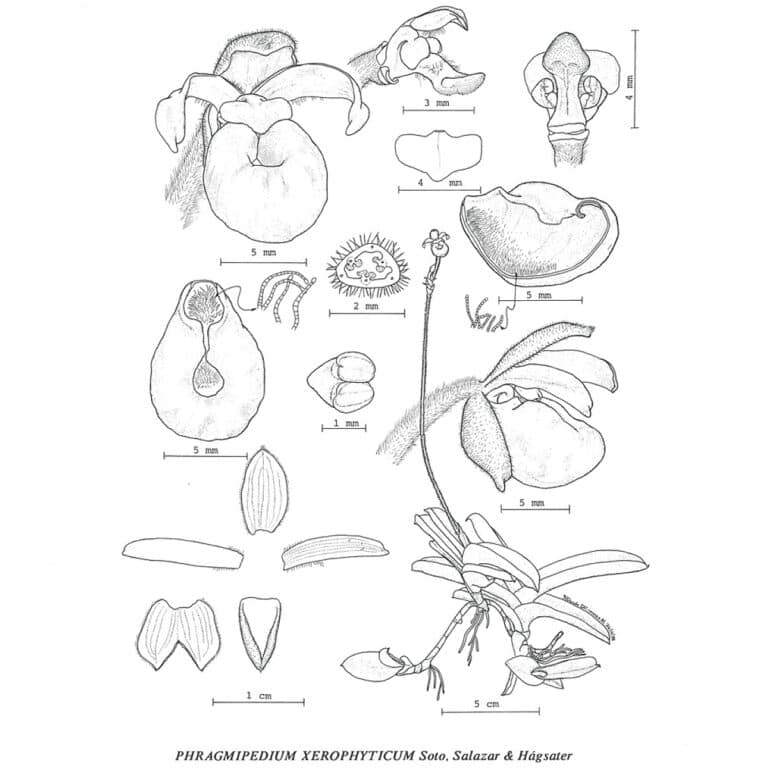
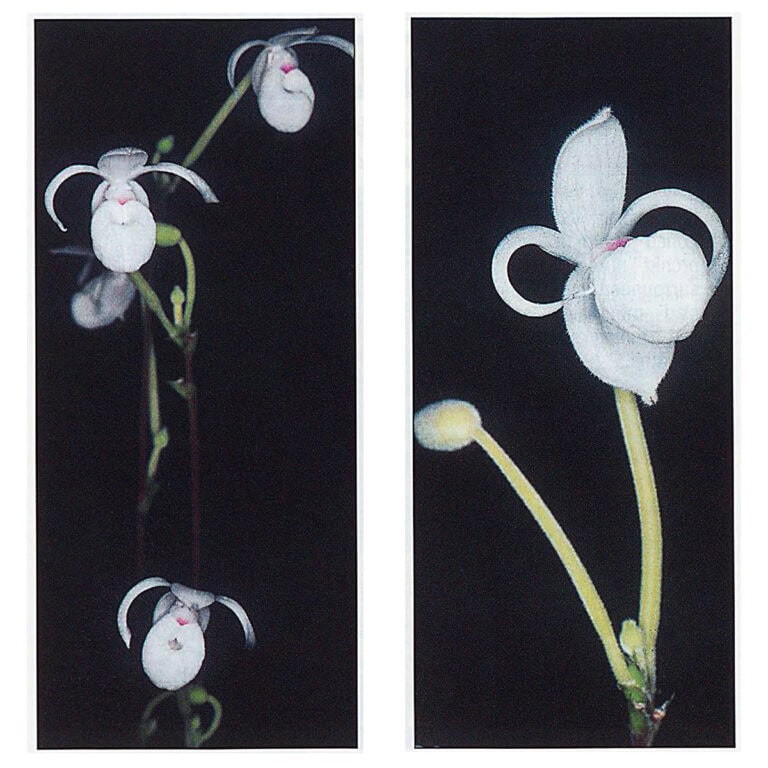
In 1990, Mexican botanists Miguel Ángel Soto Arenas, Gerardo A. Salazar and Eric Hágsater published the first scientific paper on a newly discovered species: Phragmipedium xerophyticum. Only later was it recognised that this was not just a new species, but a completely new genus of lady's slipper orchid.
Mexipedium, as a genus was first published in 1992 in the Lindleyana magazine of the American Orchid Society. In it, the evolutionary biologist Victor Albert from the United States and the British-American botanist and geneticist Mark Wayne Chase described the new and at the time quite controversial orchid genus.
Due to the rarity of the plant, cultivation information was scarce at the end of the 20th century. In 1995, the conditions under which Phragmipedium xerophyticum could be successfully cultivated were described for the first time. Harold Koopowitz also explained why, in his opinion, the new lady's slipper orchid should not be categorised as a separate genus (Mexipedium).
Just one year later, orchid expert Marilyn LeDoux published even more detailed care instructions for Phragmipedium xerophyticum. This contained very detailed information, such as the procedure for creating a suitable substrate. In 1990, LeDoux was one of the first people ever to receive plants from Mexico for her studies on the species.
In Curtis's Botanical Magazine, Vol. 13, No. 3 in 1996, a colour illustration of Mexipedium xerophyticum was published alongside a detailed description containing useful information of the species. It was created by the well-known botanical illustrator Carol Woodin.
The fact that the plant was gradually becoming more widespread in collections around the world was evident from the publication in the ‘Australian Orchid Review’ in 2002, in which the author shared his experiences in the cultivation of Mexipedium xerophyticum with the readership.
Because the discovery of Mexipedium xerophyticum is so important in the orchid world of Mexico, the species was also featured in the 2003 publication on the orchids of Mexico. The illustration is based on the first description of the species published 1990.
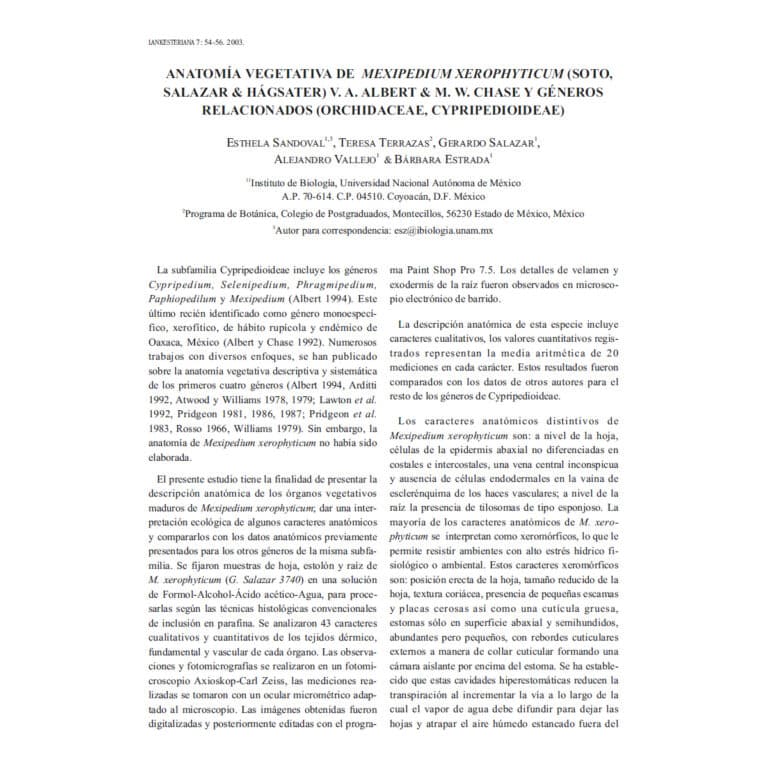
The aim of the scientific publication from 2003 was to describe the anatomical characteristics of the species in more detail. Particularly characteristic are the water-storing organs as an adaptation to the dry period during the spring with only little water.
17 years after the species was first described, the Mexican botanist Miguel Ángel Soto Arenas writes a technical data sheet on Mexipedium xerophyticum. Together with his botanist colleague Rodolfo Soláno-Gomez, an updated description of the orchid species was created.
In 2009, the Peninsula Orchid Society published a cultivation guide written by Marilyn LeDoux. As in the 1996 publication, LeDoux provides useful information on the successful cultivation of the species, this time using the genus name Mexipedium.
One of the most informative publications on the species since its first description is from 2010. It deals with the rediscovery of the species and contains many photographs of the habitat of Mexipedium xerophyticum and current information on the rather precarious situation of the population in the wild.
Three years after its publication in 'Die Orchidee', the magazine 'Orchideen Zauber' is now also dedicated to the rare species Mexipedium xerophyticum. The richly illustrated article not only offers practical cultivation tips, but also a compact profile of the plant. The title is “One of the rarest orchids in the world”.
Even National Geographic has already published an article about Mexipedium xerophyticum. The original language of the publication from 2023 is Spanish and was written by two journalism students from the Universidad Iberoamericana in Mexico City. The text contains interesting statements from various researchers who have studied the species.
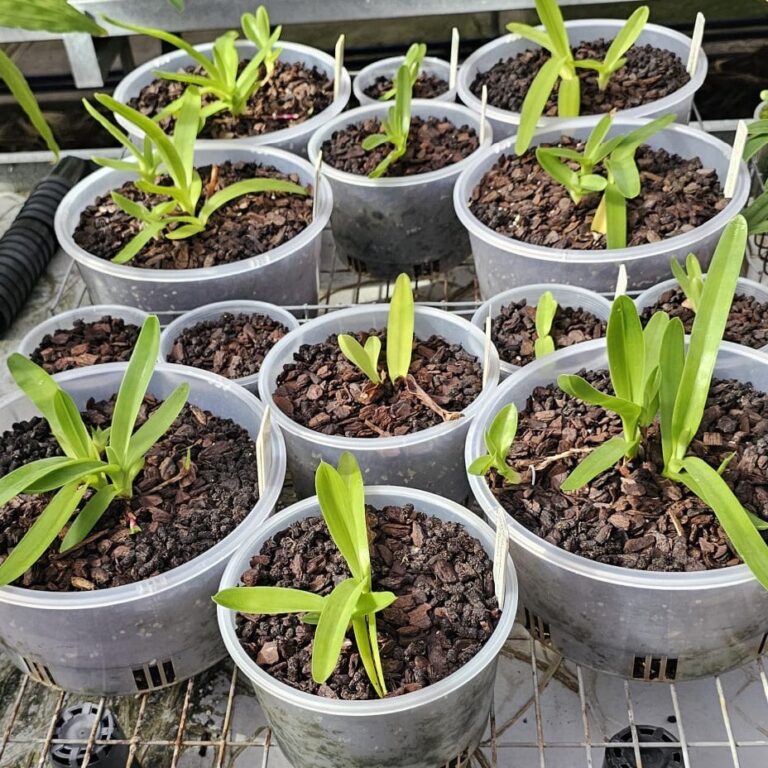
In 2024, the Paphiopedilum Society of New South Wales in Australia published an article in its magazine 'PAPH. illustrated', which takes a closer look at the cultivation of Mexipedium xerophyticum. The climate diagrams of the natural habitat of Mexipedium xerophyticum provide important information on the right cultivation conditions.