
Pollination
Pollination of Mexipedium xerophyticum
It is still unclear which animal acts as the pollinator for Mexipedium xerophyticum in the wild . It is suspected that a very small species of wasp might be responsible. Because this orchid species is so rare and its natural habitat is virtually inaccessible, no long-term observations or even on-site studies have been conducted to date. Given that no young plants have been observed in the natural habitat, one might even speculate whether the pollinating insect still exists there at all or whether it may have gone extinct itself.
The flower anatomy of lady’s slipper orchids has generally been well studied, and because Mexipedium xerophyticum has the same floral morphology as Phragmipedium, Paphiopedilum, Cypripedium, and Selenipedium, a precise statement can be made about how the pollination process works, despite the lack of information about the pollinating insect. The following illustration, showing a longitudinal section through the flower, serves to illustrate the individual stages of this process:
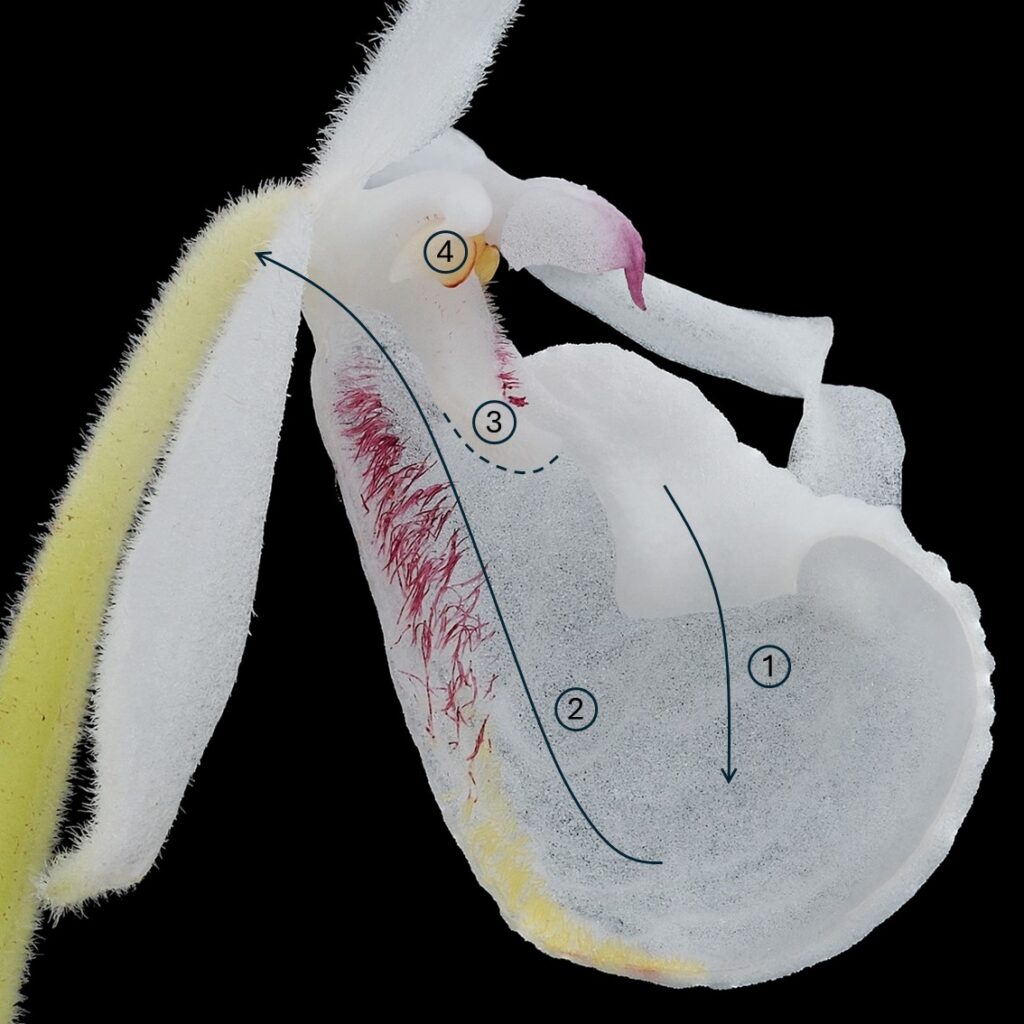
1: Falling Into the Pouch
The flowers of Mexipedium xerophyticum attract insects with their color and scent. When an insect lands on the flower, it slips into the pouch. The smooth inner walls and the inward-curving edges of the opening prevent it from climbing back out the same way.
2: Searching for a Way Out
The insect tries to escape and finds only one way to climb up inside the flower: along the inner back edge of the lip. There, upward-curving plant hairs—known as trichomes—serve as a ladder for the trapped insect. This is the only way it can leave the flower.
3: Transfering the Pollen
If the insect has already visited another flower of Mexipedium xerophyticum, it rubs off the pollen it has carried onto the curved surface of the stigma as it squeezes past it. This pollinates the flower.
4: Picking up New Pollen
As the insect leaves the flower, it comes into contact with the pollinia (compact masses of pollen grains) at the narrow exit, and with a little luck, some new pollen sticks to its body. If it then visits a new flower, the process starts all over again.
Manual pollination of Mexipedium xerophyticum
In orchid breeding, flowers are pollinated by hand. The choice of parent plants is important, as it determines how good the expected result will be.
Due to the small gene pool of Mexipedium xerophyticum—which consists of only two clones, ‘Windy Hill’ and ‘Oaxaca,’ that found their way into orchid collections as original wild plants—the selection of suitable crossing partners is quite limited. Inbreeding is a problem when propagating this species, but unfortunately it cannot be avoided. There are simply too few plants. Furthermore, modern DNA analysis has shown that the two wild plants mentioned are also genetically very similar.
To rule out inbreeding depression as much as possible—or at least minimize it—care should be taken when breeding to ensure that, whenever possible, both original plants are included in the cross. However, this is not always possible. For example, the well-known varieties “Pixie Slippers” and “Fairy Slippers” by Marilyn Ledux (Windy Hill Orchids) both originated from a self-pollination of “Oaxaca.”
Pollinating Mexipedium xerophyticum is a challenge for fine motor skills, mainly because of the tiny flowers and their even tinier parts. The easiest way to do this is to remove all the petals. This exposes the stigma:
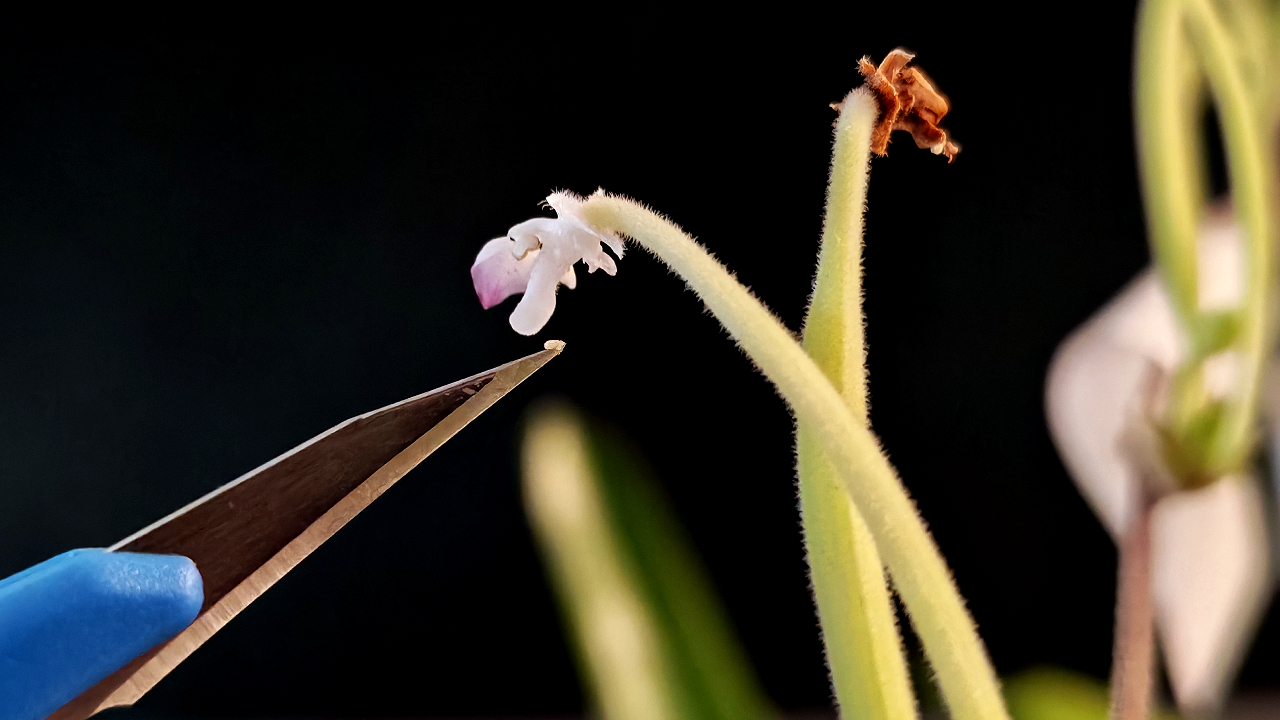
In our experience, pollination is easiest to perform using a flattened needle or a very fine scalpel. A magnifying glass with a stand can be helpful for seeing the tiny parts of the flower while you work.
First, remove one of the four pollinia from the plant that serves as the pollen donor. Then apply it to the stigma of the plant to be pollinated. The pollen mass has a slightly sticky consistency, so the pollinium usually adheres well.
In our experience, pollination works best when the flower to be pollinated still has all its pollinia intact. If these are removed, the flower may wilt before it gets pollinated.
Just a few days later, you can tell whether pollination was successful. If the seed pod remains on the plant, there’s a good chance that fertile seeds will develop inside it. After just one month, a noticeable swelling of the capsule should be visible. As the seeds mature, the contents of the capsule turn very dark, which is even visible from the outside. At that point, there’s an excellent chance that there are many seeds inside that can be successfully germinated.
After 5–6 months, the seed pod is ready for sowing.